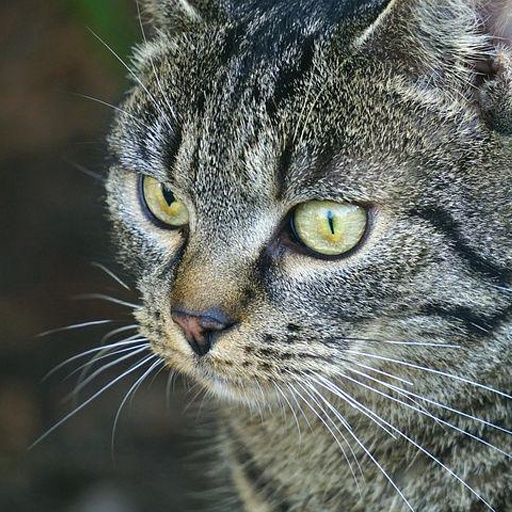
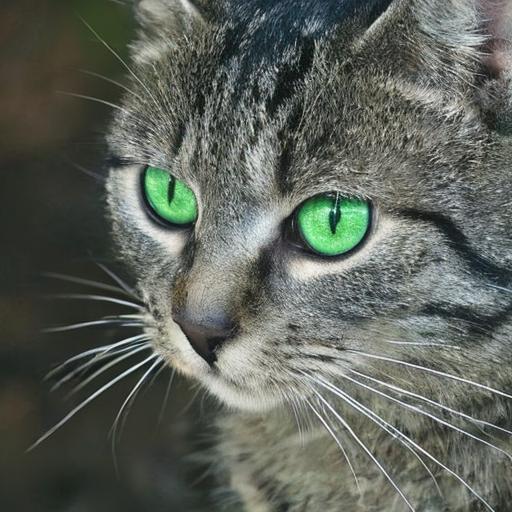
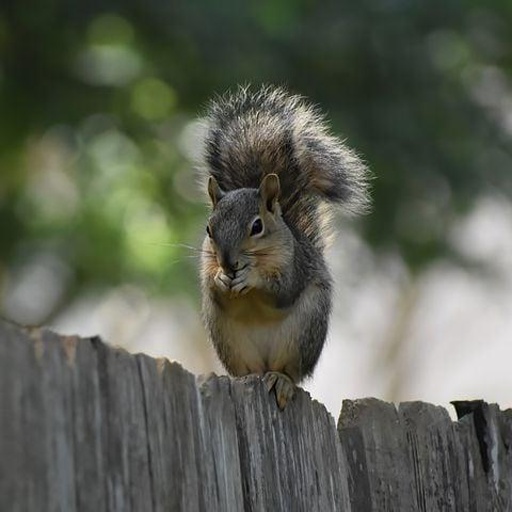
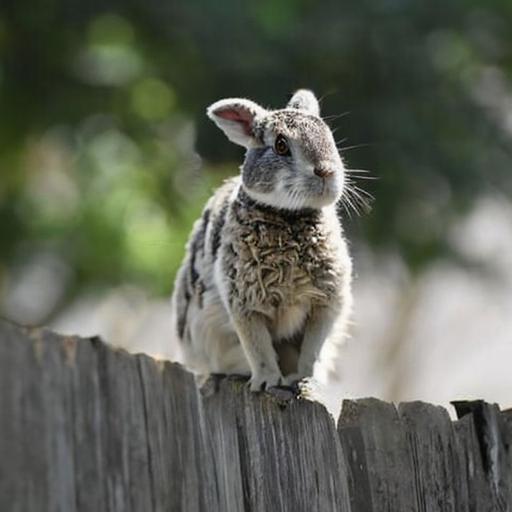
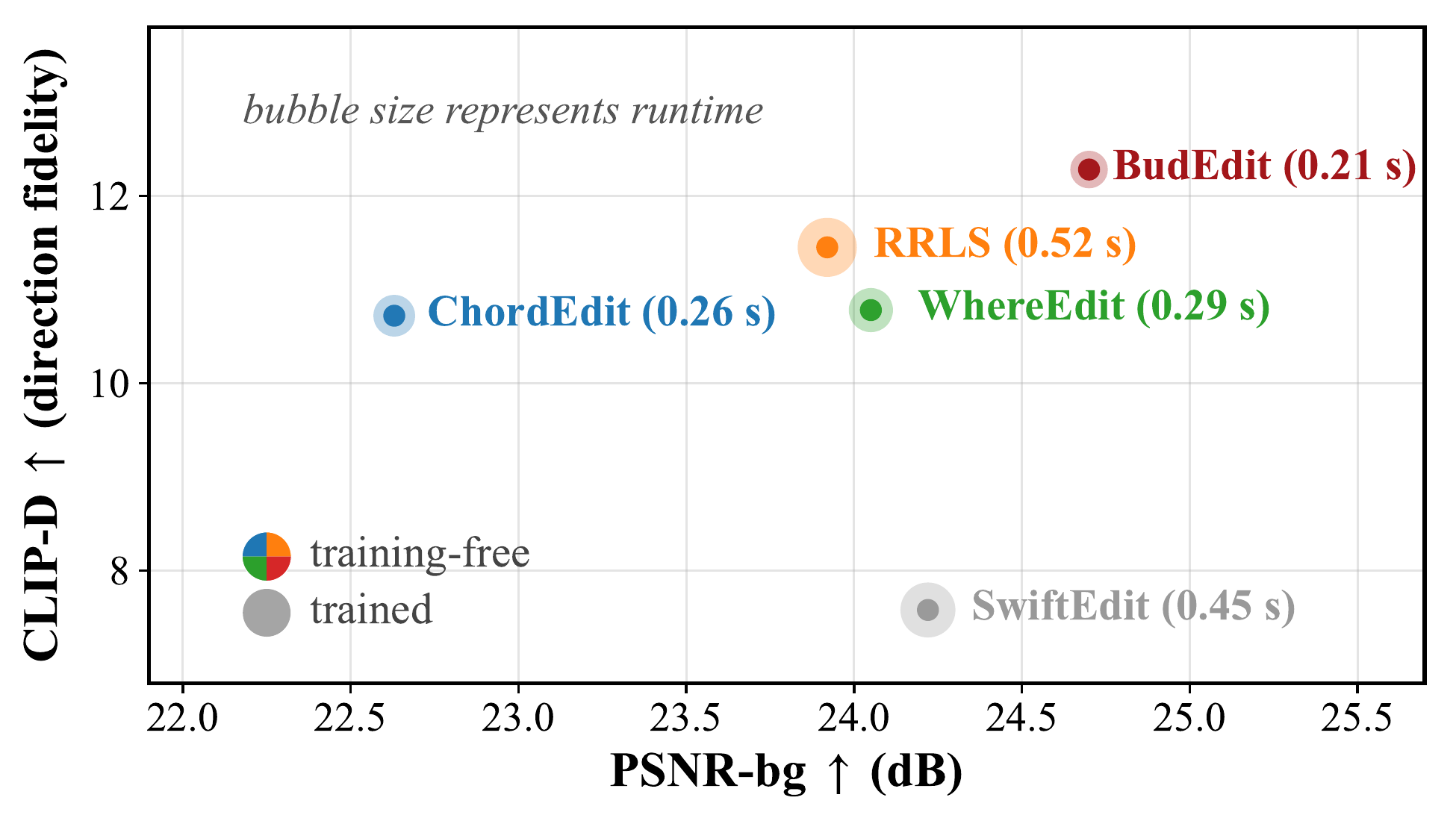
One-step text-guided diffusion editing is efficient but prone to spatially misallocated updates that distort the edited object and alter the background. Existing methods often improve stability by averaging the editing field across timesteps. We instead identify spatial energy misallocation as a distinct and measurable failure mode: across two independent noise draws, the residual field is essentially unrepeatable, making the background field unreliable for direct transport, while its total energy still sets a usable magnitude for the draw at hand. BudEdit turns that magnitude into an explicit budget and reallocates it to edit-relevant regions selected jointly by residual energy and cross-attention, controlling where editing energy is spent rather than averaging over timesteps. The resulting training-free, inversion-free editor spends the budget on transport and reuses it to scale a correction in a lower-noise gated refinement. The budgeted injection field matches its prescribed budget exactly and vanishes on the identified background support, by construction. On PIE-Bench with SD-Turbo, BudEdit outperforms ChordEdit under each method's reported default settings on all 11 evaluated metrics, including a 2.1 dB gain in background PSNR, 31% lower DINO, and 36% lower LPIPS, while improving all five editing-quality metrics and reporting the lowest runtime in the comparison.
BudEdit separates how much editing energy is administered from where and how it is spent. A residual-energy support and a cross-attention localization signal, both read off the same transport forward pass at no additional UNet evaluation, determine where the budget is allocated, while a constrained allocation problem determines how it is distributed.
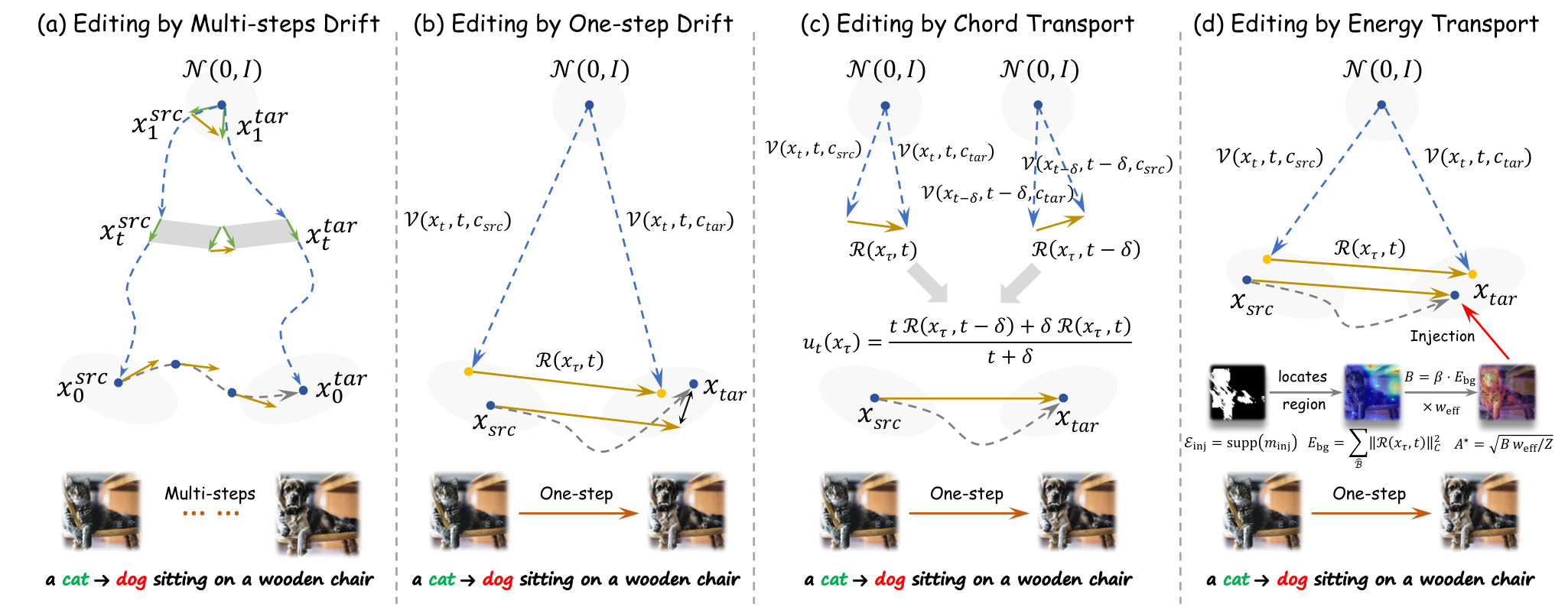
Harvesting the budget. The aggregate residual energy measured on the operational background support, the region outside the model's own thresholded energy support, sets an image-dependent budget $B = \beta E_{\mathrm{bg}}$ with $\beta{=}4.0$ by default. This is a measurement-derived scale, not a conserved quantity being transported: the construction matches this prescribed budget exactly, without assuming conservation of the measured background energy. Because the budget sums rather than averages, it carries the area of the background support, so the mean injected energy density scales with that area relative to the injection support: a small target on a large canvas receives a denser correction.
Allocation as information projection. Within the effective injection support, where the residual-energy support meets a prompt-difference attention gate, the budget is distributed by solving a KL-projection problem in closed form. The resulting amplitude map matches the attention-derived allocation profile exactly while consuming exactly the prescribed budget, and vanishes everywhere on the background support by construction.
Budget-aware gated refinement. A second forward pass at a lower noise level, reusing the noise realization of the transport pass, cleans up the transported image. Within a cleanup gate — the thresholded, dilated second-pass attention readout intersected with the second-pass energy support — GatedRefine starts from the target-conditioned prediction, reinjects a fraction of the same budget $B$ as a residual correction, and applies a gated local extrapolation to recover reliable but under-edited content; a low-amplitude high-frequency source anchor and an attention-modulated micro-swap then restore local texture and stabilize uncertain structure. Final fusion with the source image is governed by an output gate that keeps the transport support admitted by second-pass attention and adds only extensions jointly supported by the second-pass residual and attention.
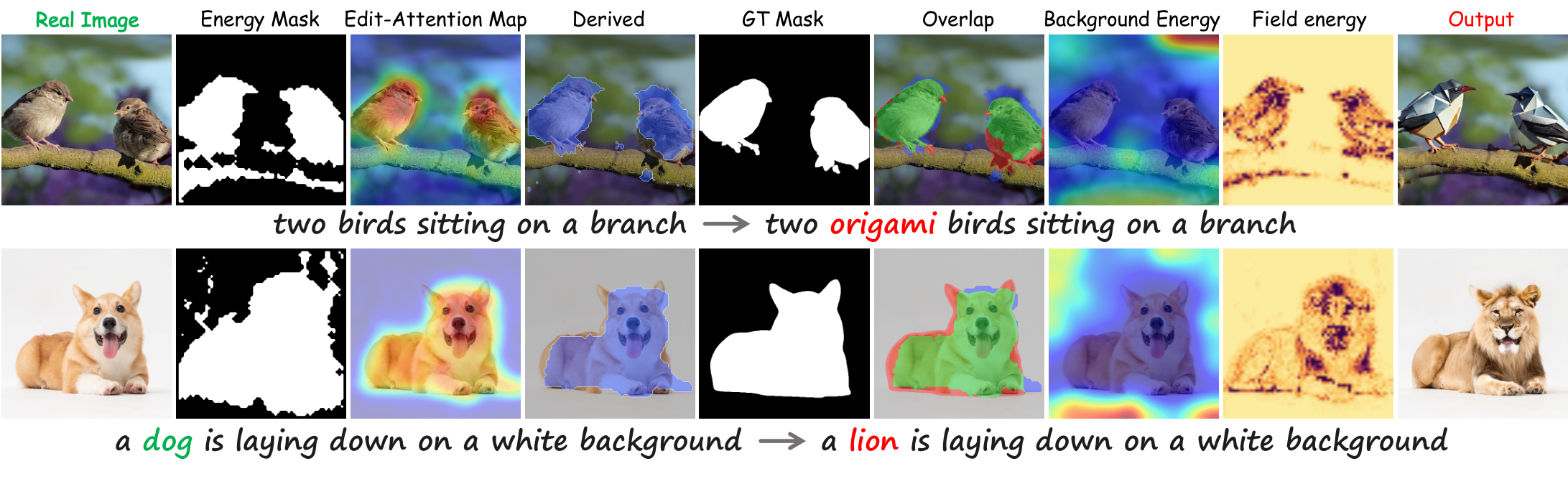
Localization derives from the model itself. The residual-energy mask and the edit-attention map intersect to form the derived mask; editing uses no external or human-annotated mask, and the GT mask above is included for visual comparison only. In the Overlap panel, green marks the common support of the derived mask and the GT mask, while red and blue mark regions selected by only one of them. The appendix reports the overlap between the derived support and the annotated region over all $700$ pairs.
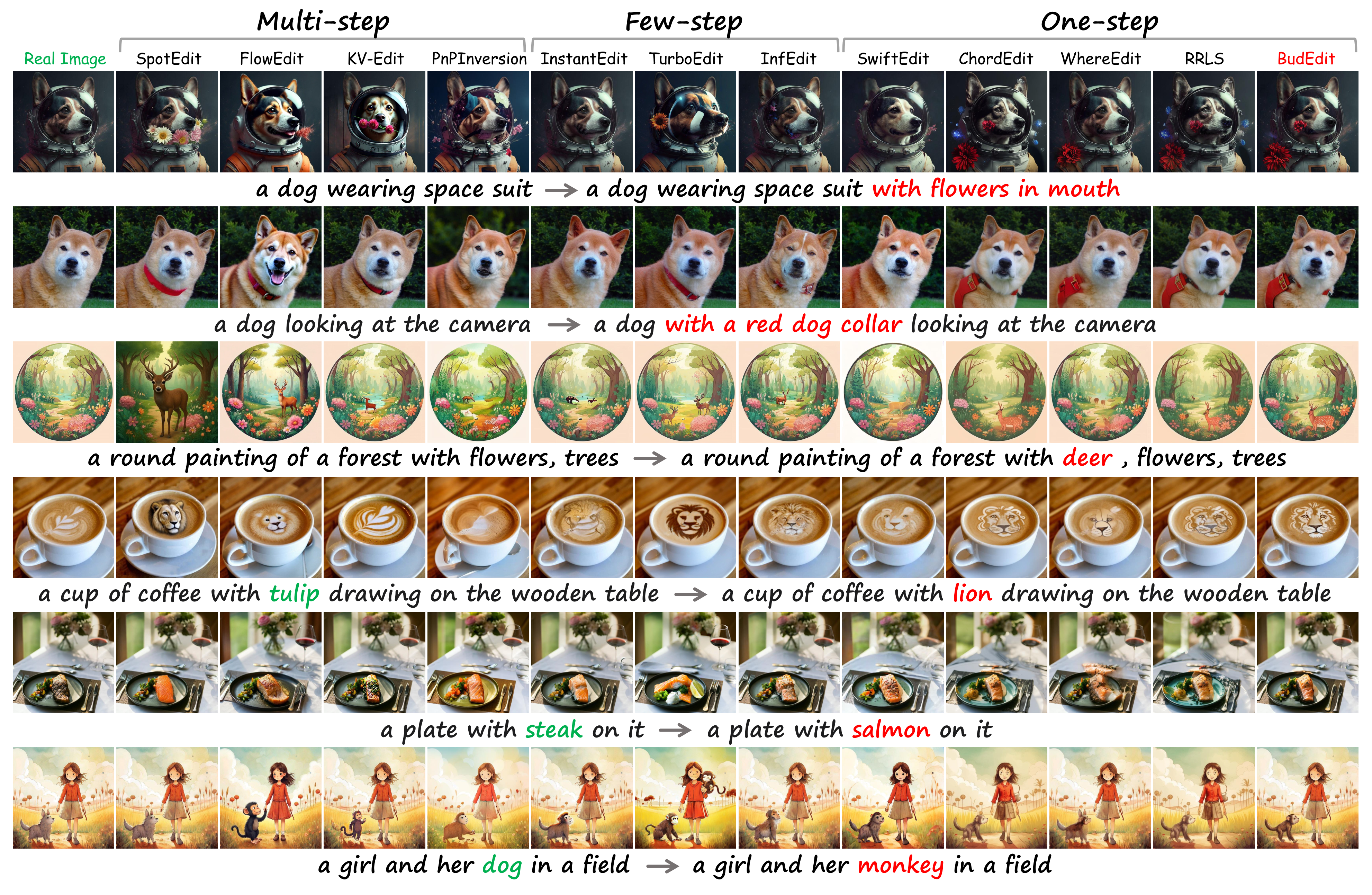
On PIE-Bench with SD-Turbo (700 images, 10 editing categories, all $512{\times}512$, seed fixed at 42 for all methods), BudEdit is compared against multi-step, few-step, and one-step editors under each method's own reported default configuration. Like ChordEdit, BudEdit uses one sampling step and two UNet evaluations, with $t_s{=}0.78$, $t_e{=}0.38$, $\alpha{=}0.7$ and $\beta{=}4.0$; runtimes are measured on an RTX 4090. Among one-step methods, BudEdit achieves the highest PSNR, CLIP-D, MUSIQ and MUSIQ-E while using two UNet evaluations and reporting the lowest runtime of 0.21 s per image. Among training-free one-step editors it leads all six background-fidelity metrics and exceeds ChordEdit on all five editing-quality metrics — a 2.1 dB background PSNR gain, 31% lower DINO, and 36% lower LPIPS — while SwiftEdit reaches its background numbers only with task-specific training. The few-step and multi-step methods provide a broader quality–compute reference rather than a same-budget ablation: they use $4$–$100$ evaluations and report $0.84$–$15.03$ s per image, compared with BudEdit's two evaluations and $0.21$ s.
| Type | Method | Background | Edited | Properties | Efficiency | |||||||||||||
|---|---|---|---|---|---|---|---|---|---|---|---|---|---|---|---|---|---|---|
| PSNR↑ | MSE↓ | LPIPS↓ | SSIM↑ | DINO↓ | CLIP↑ | CLIP-W↑ | CLIP-E↑ | CLIP-D↑ | MUSIQ↑ | MUSIQ-E↑ | T-free | I-free | Step | NFE | Runtime(s)↓ | VRAM(MB)↓ | ||
| Multi-step | SpotEdit | 27.21 | 13.92 | 69.39 | 0.88 | 41.55 | 96.64 | 24.64 | 22.51 | 17.63 | 67.01 | 60.04 | ✓ | ✓ | 50 | 50 | 11.37 | 26384 |
| FlowEdit | 22.12 | 8.91 | 104.71 | 0.84 | 26.88 | 95.12 | 26.01 | 22.78 | 10.90 | 69.39 | 63.72 | ✓ | ✓ | 33 | 33 | 9.39 | 20180 | |
| KV-Edit | 34.91 | 0.52 | 11.26 | 0.95 | 16.57 | 97.06 | 24.56 | 20.83 | 7.95 | 71.11 | 62.10 | ✓ | ✓ | 24 | 48 | 9.42 | 31618 | |
| PnPInversion | 22.32 | 8.29 | 112.77 | 0.79 | 28.11 | 95.03 | 25.42 | 22.53 | 10.43 | 68.82 | 61.17 | ✓ | ✗ | 50 | 100 | 15.03 | 9290 | |
| Few-step | TurboEdit | 22.55 | 9.25 | 101.93 | 0.80 | 29.87 | 95.24 | 26.54 | 23.04 | 14.62 | 71.11 | 63.83 | ✓ | ✓ | 4 | 4 | 0.91 | 19574 |
| InstantEdit | 28.61 | 2.79 | 45.21 | 0.87 | 12.72 | 97.41 | 24.89 | 21.93 | 13.06 | 67.38 | 60.41 | ✓ | ✗ | 4 | 8 | 0.84 | 7812 | |
| InfEdit | 28.11 | 6.98 | 56.09 | 0.85 | 16.90 | 97.32 | 24.87 | 22.07 | 9.65 | 67.54 | 60.83 | ✓ | ✓ | 4 | 4 | 1.29 | 6794 | |
| One-step | SwiftEdit | 24.22 | 5.41 | 76.39 | 0.82 | 15.14 | 96.34 | 24.48 | 21.54 | 7.56 | 66.52 | 60.05 | ✗ | ✗ | 1 | 2 | 0.45 | 19500 |
| ChordEdit | 22.63 | 7.98 | 122.66 | 0.77 | 28.81 | 95.04 | 24.83 | 22.15 | 10.72 | 67.21 | 60.19 | ✓ | ✓ | 1 | 2 | 0.26 | 7333 | |
| WhereEdit | 24.05 | 7.97 | 108.22 | 0.80 | 31.03 | 94.93 | 25.18 | 22.66 | 10.78 | 64.28 | 56.39 | ✓ | ✓ | 1 | 3 | 0.29 | 7339 | |
| RRLS | 23.92 | 6.27 | 111.40 | 0.81 | 25.07 | 95.21 | 25.38 | 22.09 | 11.47 | 65.90 | 57.79 | ✓ | ✓ | 1 | 4 | 0.52 | 7333 | |
| BudEdit | 24.71 | 5.54 | 78.24 | 0.82 | 20.01 | 96.17 | 25.25 | 22.52 | 12.28 | 67.77 | 60.31 | ✓ | ✓ | 1 | 2 | 0.21 | 7319 | |
← Scroll horizontally to see all columns →
Quantitative comparison on PIE-Bench. T-free: training-free. I-free: inversion-free. Best and second-best among one-step methods are highlighted in yellow and blue, ties included.
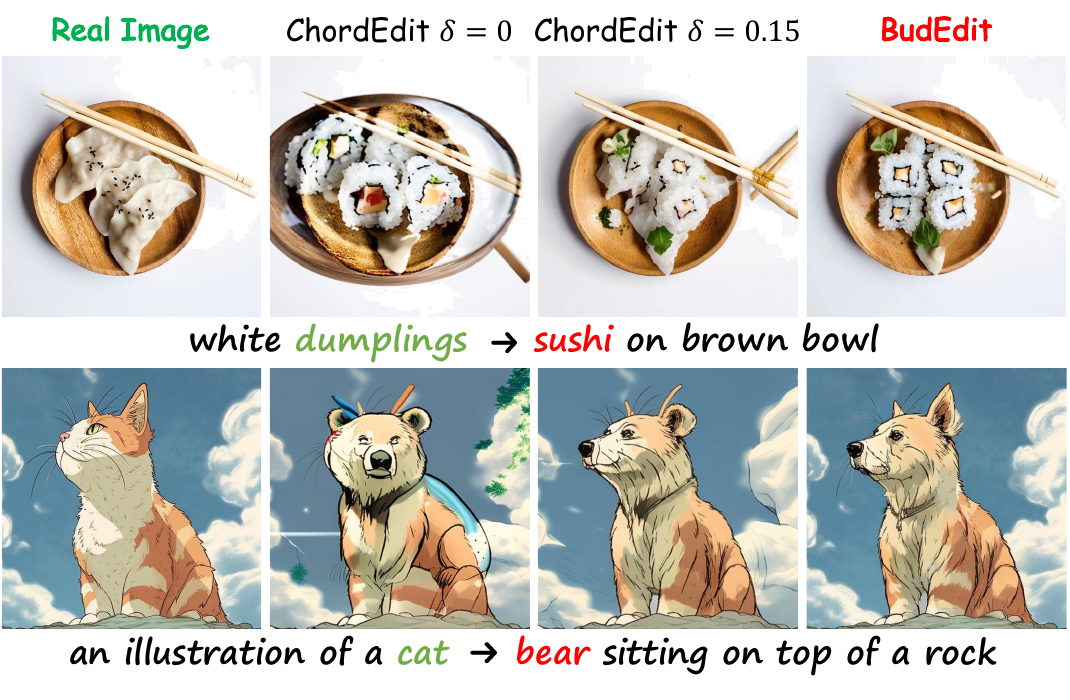
Comparison with chord transport. Disabling ChordEdit's chord window ($\delta{=}0$) raises CLIP-E from $22.15$ to $22.54$, but lowers MUSIQ-E from $60.19$ to $55.97$ and background PSNR from $22.63$ to $20.13$ dB, and the window-off outputs show visible background and structural distortion. CLIP-E alone therefore does not fully reflect edit quality, which is why MUSIQ-E is reported as a complementary measure of edited-region perceptual quality. Without relying on temporal smoothing, BudEdit improves all five metrics over ChordEdit's smoothed default; against the window-off row it gives up only $0.02$ CLIP-E while improving background PSNR by $4.58$ dB and MUSIQ-E by $4.34$ points.
Matched effective timestep. ChordEdit's default window assigns six sevenths of its weight to $t_s-\delta$, so with $t_s{=}0.9$ and $\delta{=}0.15$ its weighted-average time is $t_s-6\delta/7=0.771$, close to BudEdit's direct timestep $t_s{=}0.78$. This is consistent with temporal smoothing shifting ChordEdit toward a lower effective timestep, while the mechanisms remain different: ChordEdit averages fields globally over time, whereas BudEdit evaluates directly at $t_s{=}0.78$ and controls the trade-off through spatial energy budgeting.
| Config | PSNR↑ | MSE↓ | CLIP-W↑ | CLIP-E↑ | MUSIQ-E↑ |
|---|---|---|---|---|---|
| δ=0 | 20.13 | 13.34 | 25.11 | 22.54 | 55.97 |
| δ=0.15 | 22.63 | 7.98 | 24.83 | 22.15 | 60.19 |
| BudEdit | 24.71 | 5.54 | 25.25 | 22.52 | 60.31 |
ChordEdit chord window ablation. $\delta{=}0.15$ is the default; $\delta{=}0$ disables the window.
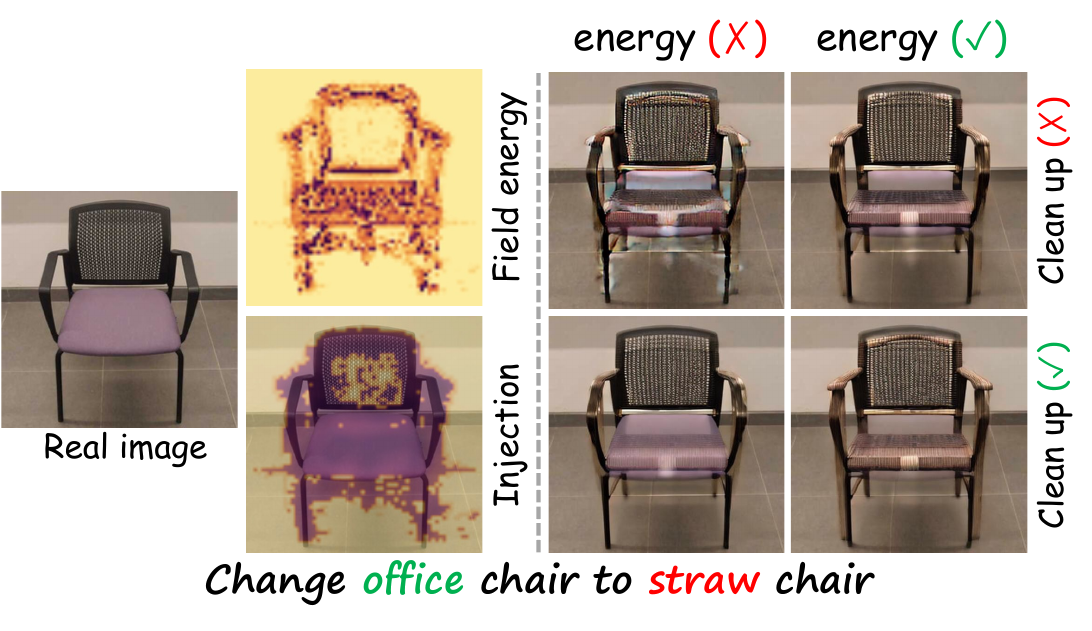
Component ablations. Setting $\beta{=}0$ drops the budgeted injection field $f^{\star}$ from the composed field, leaving only the attenuated residual term; disabling cleanup drops the second UNet evaluation, halving NFE. Each factor helps alone: energy reallocation alone raises CLIP-E/CLIP-D by $0.31$/$1.57$ without cleanup, while cleanup gives the larger editing-quality gain, $+1.30$/$+5.87$ and $+1.08$ CLIP-W. They also interact — with cleanup on, the reallocation gains grow to $0.71$/$2.93$ — and the full configuration attains the best CLIP-W, CLIP-E and CLIP-D. Transporting less energy changes the background less, so the no-energy, no-cleanup setting holds the highest PSNR and SSIM. In the office chair $\to$ straw chair edit, budgeted energy reallocation alone overlays straw texture on the cushion, cleanup alone yields only a slight change to the armrests, and only the full configuration converts the chair coherently.
| Energy | Cleanup | PSNR↑ | SSIM↑ | CLIP-W↑ | CLIP-E↑ | CLIP-D↑ | NFE↓ |
|---|---|---|---|---|---|---|---|
| ✗ | ✗ | 26.14 | 0.85 | 23.51 | 20.51 | 3.48 | 1 |
| ✓ | ✗ | 25.73 | 0.84 | 23.73 | 20.82 | 5.05 | 1 |
| ✗ | ✓ | 25.92 | 0.83 | 24.59 | 21.81 | 9.35 | 2 |
| ✓ | ✓ | 24.71 | 0.82 | 25.25 | 22.52 | 12.28 | 2 |
Factorial ablation of energy reallocation and cleanup. Highlighted cells mark column best.
The comparison crosses two datasets, PIE-Bench and the multi-aspect PIE-Bench++ of ParallelEdits, with two one-step backbones, SD-Turbo and SwiftBrushV2, using the same hyperparameters throughout. BudEdit achieves the best background preservation and editing quality across all four settings, improving background PSNR by over $2$ dB. The appendix reports all eleven metrics.
| Dataset | Backbone | PSNR↑ | CLIP-E↑ | ||
|---|---|---|---|---|---|
| ChordEdit | BudEdit | ChordEdit | BudEdit | ||
| PIE-Bench | SD-Turbo | 22.63 | 24.71 | 22.15 | 22.52 |
| SwiftBrushV2 | 22.93 | 25.49 | 21.18 | 21.26 | |
| PIE-Bench++ | SD-Turbo | 22.87 | 25.06 | 24.12 | 24.27 |
| SwiftBrushV2 | 23.16 | 25.83 | 22.46 | 22.70 | |
Quantitative comparison on different datasets and backbones. Blue marks BudEdit.
BudEdit addresses spatially misallocated updates in one-step diffusion editing by converting single-draw background residual energy into an image-dependent budget and re-injecting it into the regions selected jointly by residual energy and cross-attention, with exact injection-budget matching and zero injection on the operational background support. On PIE-Bench, it outperforms the temporal-smoothing approach of ChordEdit on all 11 reported metrics, including a 2.1 dB PSNR gain, at the lowest runtime in the comparison. Together, these results establish explicit spatial energy budgeting as an alternative to temporal smoothing for stable, efficient, controllable one-step editing.
@article{zhou2026budedit,
  title   = {Beyond Temporal Smoothing: Spatial Energy Budgets Stabilize One-Step Diffusion Editing},
  author  = {Zhou, Shengxiao and Luo, Lei and Yang, Jian},
  journal = {arXiv preprint arXiv:2609.32841},
  year    = {2026}
}